Beyond the Playlist Pitch (Part 2) - Aura
The Raw Data, The Ratios, and the Final Verdict
By Markus ·
n Part 1, we analyzed the mechanics behind Aura: a platform designed to bypass the friction of the Meta Ads Manager by generating automated, direct social media campaigns from a single track link. The theory sounded highly promising targeting intentional listeners, driving higher conversion rates, and building long-term catalog growth rather than relying on short-lived playlist spikes.
To see if the platform actually delivers on its dashboard promises, we put it through a 14-day independent stress test using an independent electronic track. Here is the breakdown of the data, entirely transparent and pulled directly from both the campaign backend and Spotify for Artists.
The Campaign Setup
Test Track: Independent Electronic Release
Duration: 14 Days (September 9 – September 23, 2026)
Budget: $149 (Growth Package)
Objective: Generate qualified traffic and activate highly engaged listeners across major streaming platforms.
The Acquisition: Intent and Platform Ratios
The fundamental difference between playlist pitching and direct ads lies in listener intent. When someone clicks a feed ad, lands on a routing page, and actively opens Spotify or Apple Music, they are making a conscious choice to listen.
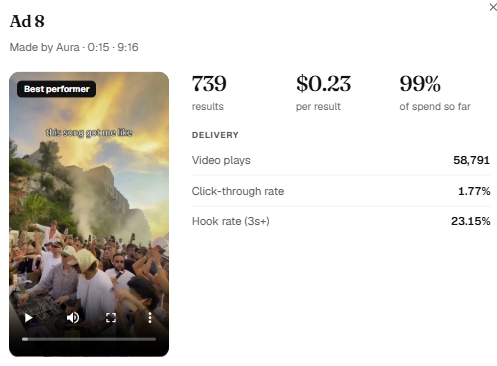
Cost Efficiency: Broken down against the $149 budget, the campaign acquired qualified listeners at an average cost of just $0.20 per result. Aura’s internal benchmark classified this performance as "Outstanding."
Platform Split: Out of the total converted audience, roughly 70% chose Spotify, while the remaining 30% routed to Apple Music. This underscores the critical value of using smart links rather than forcing all traffic to a single destination.
Creative Insights
One of Aura's strongest operational advantages is automated A/B testing for creative assets. Instead of simply pushing static cover art, the engine quickly identified a runaway winner.
The visual layout dubbed "DJing with view" completely dominated the campaign, driving over 99% of the total conversions with a highly effective Click-Through Rate (CTR) of 1.86%. The raw, euphoric DJ-set energy clearly resonated with the track's target demographic, proving that dynamic, context-fitting video vastly outperforms static images.
The Reality Check: Isolating Ad Impact from Organic Baselines
To evaluate the true return on investment, we have to look past the ad dashboard and analyze the actual impact inside Spotify for Artists. A new release naturally generates saves, particularly through pre-save campaigns, so separating organic traffic from paid acquisition is critical.
The Organic Pre-Save Spike: Before the Aura campaign launched, the track experienced a typical release-day trajectory. Driven by organic momentum and pre-saves, the track saw an initial, sharp spike in saves. However, exactly as expected with organic hype, the data curve plummeted almost immediately back down to its baseline in the days following the release.
The Ad-Driven Sustained Wave: Once the Aura campaign went live, the listener profile shifted dramatically. Over the 14-day ad cycle, Spotify registered continuous, sustained growth. The intent of these ad-acquired listeners translated into massive engagement: looking at the ratio of routed Spotify clicks from the ad dashboard compared to the actual saves registered in the Spotify backend, we saw an astonishing conversion rate of over 80%. This resulted in a massive 296.4% increase in saves compared to the previous period.


The Algorithmic Tail: The ultimate test of any paid campaign is what happens when the budget runs out. As expected, daily saves and streams decreased after the ads concluded. However, unlike the steep drop-off following the organic release spike, the post-campaign baseline settled at a distinctly higher, healthier level. By consistently feeding the algorithm high-intent data, the track legitimized itself within Spotify's ecosystem, enabling it to continue capturing algorithmic momentum long after the ad spend stopped.
The Final Verdict
Aura delivers exactly what it promises: a clean, frictionless bridge between social media scrolling and genuine catalog growth. While it does not replace grassroots community building or traditional PR, paying $0.20-$0.23 per listener to acquire fans who actively save the music is one of the most efficient infrastructure investments an independent artist can make.
Looking purely at this brief 14-day test run, seeing a roughly 3-to-1 increase in the save rate is a massive win. When you consider that many campaigns require extended A/B testing phases, and algorithmic traction often takes more than two weeks to truly kick in, generating this level of momentum so early makes Aura a highly effective tool from our perspective.
👉 Start your own campaign on Aura here
 |
Header Image: AURA (Promo Material, editorially adapted)
As with anything in this industry, please always do your own research, form your own opinion, and see if it matches your vibe and workflow.